
"The world is not a problem to be solved; it is a living being to which we belong." , Lois Farrow Parshley, translating Simone Weil
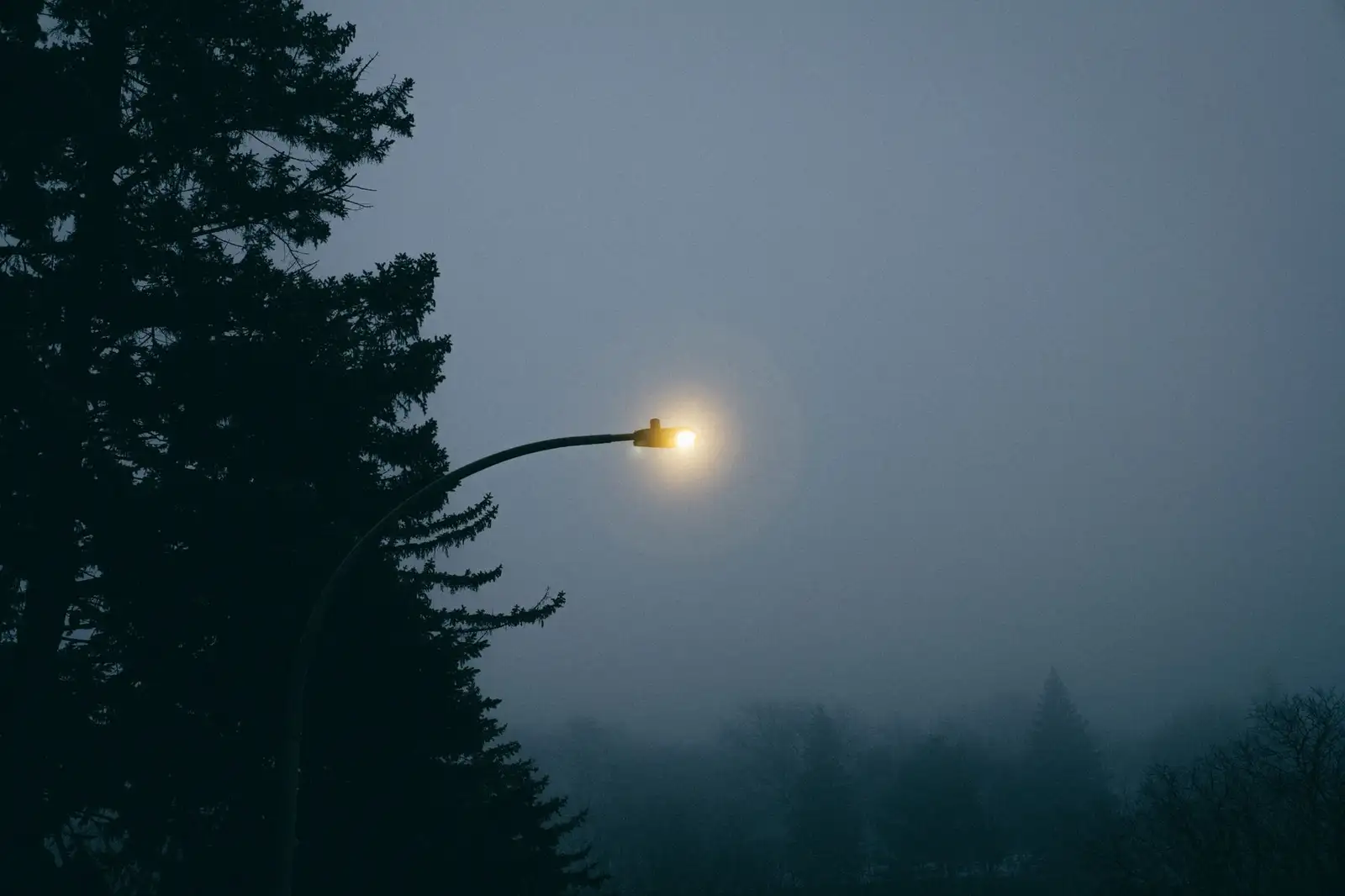
There is a morning I keep returning to. Not because anything happened. Nothing did. I was standing at a bus stop in London sometime in December, years ago now, and the fog had come in overnight and settled over everything like a held breath. The streetlamps were still on (it was maybe half past seven, still dark enough) and each one wore a halo of diffused amber light that seemed less like illumination and more like suggestion. As if the lamp itself wasn't sure what it was trying to show you.
I missed my bus. Stood there watching.
Fog changes the physics of light in ways that feel almost personal. It doesn't block the lamp so much as redistribute it, spread it thin across the air until the beam loses all direction and becomes something else entirely, a mood, a presence, a soft insistence that something is here even if you can't quite make it out. The NOAA describes this as forward scattering, the way water droplets in fog redirect light particles away from their source, which sounds clinical and probably is, but it doesn't fully account for what it feels like to stand inside it at seven in the morning when you're already late and then suddenly, inexplicably, aren't.
What it feels like is: a pause you didn't ask for.
Most mornings, I think we move through the city the way water moves through pipes: directed, purposeful, mostly unconscious of the route. We know the bus times. We have the coffee. The podcast is already queued. There's a specific kind of efficiency to the morning commute that has nothing to do with speed and everything to do with not being present. The body gets you there. The mind is already at the desk.
And then the fog comes.
It doesn't stop you exactly. You still make the bus, usually. You still arrive. But the quality of attention shifts, the way a dream sometimes sharpens right before waking. The familiar street becomes briefly strange. And strangeness, I've come to believe, is one of the few things that can genuinely interrupt the autopilot.
The streetlamp does this work quietly. Modestly. It doesn't demand anything of you.
I've been thinking about why this image (lamp, fog, morning) seems to find me at certain points in my life. Not in London alone. There was a week I spent in Umbria once, years before I understood what it meant to slow down, when the hill towns were wrapped in November fog for days at a stretch and the streetlamps along the old walls glowed like figures from a Flemish painting. Warm and small and absolutely sure of themselves despite the obscurity surrounding them. I remember thinking: how does a lamp manage to look certain?
That's probably a ridiculous thing to think about a lamp.
But I kept thinking it.
There's a quality to early morning fog that afternoon fog doesn't have. By afternoon, fog feels like an inconvenience, a hazard, something to check the weather app about. But in the morning, before the day has declared its intentions, fog feels more like a condition of the mind than the air. The world has not yet committed to being visible. You're both in the same state: uncertain, half-formed, feeling your way toward what comes next.
The lamp in that context becomes a kind of company.
Not guidance, exactly. I want to be careful here, because there's a temptation to turn this into doctrine: to say that the lamp represents hope or direction or resilience through darkness, and all of that would be technically true and also completely beside the point. The lamp doesn't know you're there. It came on automatically when the light sensor triggered at dusk, and it will go off when the sensor reads enough daylight, and it has no opinion about your morning or your fog or your uncertainty.
And yet.
I read somewhere (I'm not entirely sure where, so take this loosely) that humans are among the few animals who actively seek sources of light even when they're not cold, not threatened, not navigating. We'll sit by a fire we don't need. We'll stop on a bridge to watch the reflection of streetlamps in water. We gather around lit windows in the dark. There's an impulse in us that moves toward the glow before reasoning catches up and asks why.
Maybe it's old circuitry. Maybe it's something else.
In Sei Shonagon's The Pillow Book (written in tenth-century Japan, a culture whose relationship to light and atmosphere was calibrated differently than ours) she lists among the things that make her heart beat faster: the sight of a fire glowing in the darkness. Not a fire that warms her or cooks her food. Only the sight of it. The aesthetic fact of it. The pure thereness of light in the dark.
I find that oddly comforting. That a thousand years ago, a woman sitting alone noticed a glow and felt what she couldn't entirely name and wrote it down anyway.
The commuters around me that December morning in London were doing what commuters do. Phones out. Earbuds in. The fixed forward gaze of people who have agreed, collectively, not to see each other. I don't say this critically; I'm usually one of them. But the fog had done to the air that morning, a softening of the usual ambient aggression of a city waking up, and I noticed that two or three other people at that stop were also just... looking. At the lamps. At the halos of amber dissolving into grey.
No one said anything. We didn't make eye contact. But there was a brief shared quality to the attention, a small community of noticing, that felt like arrival.
Worth noting. Worth sitting with.
I've spent a good portion of my adult life helping people find their way into places they don't know: into foreign kitchens, unfamiliar villages, towns where they don't speak the language and can't read the signs. One thing I've noticed, after more years than I can easily count now, is that the moments people remember most are rarely the ones they planned for. It's not the famous view or the celebrated meal. It's the Tuesday morning when the fog came in off the hills and they stood at the window of a farmhouse and felt, without being able to explain it, that they were exactly where they were supposed to be.
The fog, again. And the light inside it.
There's a specific visual quality to lamplight in fog that painters have chased for centuries and that digital photography still struggles with. The glow doesn't have edges. It bleeds. It exists in a radius of influence rather than a cone of direction, and standing at the center of that radius, directly beneath the lamp, the effect is almost dizzying. You're inside the light. The light is inside you. The distinction between illuminated and unilluminated feels less firm than it usually does.
I'm not being mystical. I mean that ordinary vision (this is lit, that is dark, here is where the light stops) dissolves in fog, and what replaces it is continuous, ambiguous. The whole visible world becomes a gradient rather than a boundary.
And boundaries, I think, are part of what makes ordinary mornings feel so relentless. The line between where you are and where you need to be. The line between the self you went to sleep as and the self required by the day ahead. Fog softens those lines. Not forever. Not even for long. But for the minutes you're standing in it, watching the lamp do its uncertain work, the world feels less insistently divided against itself.
There's a version of this essay that would end by telling you to slow down. To look up. To let yourself be stopped by beauty in the everyday. I understand the impulse. I've felt it. But I distrust it as an ending, because it turns an experience into instruction, and the experience I'm describing doesn't want to be instructive. It wants to be left alone to do whatever it does.
What does it do?
I'm not sure. I think it restores permission. Permission to be briefly without direction, without the forward lean of purpose, without the pretense that you know where you're going and why.
The lamp in the fog doesn't know where it's going. It's burning. Doing the one thing it does. And somehow that's enough to make the whole grey morning cohere around it, to give the shapeless air a temporary center, a place to look.
A friend of mine, a painter who works almost entirely in greys and ochres, told me once that fog is the most honest weather. Clear days lie, she said, because they suggest the world is legible, that you can see all the way to the edges of things. Fog tells the truth. The truth being: you can see about this far, and then you can't, and that's the actual situation, always, whether the air admits it or not.
I've thought about that often. (And honestly, it's part of why I find myself returning to fog as a subject rather than, say, sunlight on water, which is beautiful but somehow too resolved.)
The lamp in the fog is not a symbol of clarity. It's a symbol of something trying, within its limited radius, to make the nearby visible. That's all. And there's a kind of dignity in that: in not pretending to illuminate what's far away, in being content with the circle of light immediately available.
That December morning, I eventually got on a later bus. Arrived twenty minutes behind schedule. Sat by the window as the city reasserted itself in the growing light, the fog thinning, the lamps switching off one by one as the sensors registered morning.
I watched them go dark. Each one.
There was grace in it, the way they didn't fight the returning light, didn't insist on remaining lit once the day arrived. They'd done what they could in the dark and the fog, and now the dark and the fog were lifting, and they let go of that particular work without ceremony.
I thought about that on the bus for a while. Then I thought about other things. Then I arrived, and the day began, and the fog was gone by noon.
But I'm still thinking about those lamps. Clearly.
If you're curious about what actually happens to light in fog (the physics of why that halo forms, why the glow feels so different from ordinary lamplight on a clear night) the NOAA's guide to fog safety and visibility near artificial light sources explains the optics in useful, grounded terms. It won't tell you why it's beautiful. That part you have to stand in yourself.
Rebecca Solnit writes, in A Field Guide to Getting Lost, that the world is blue at its edges and in its depths. She's talking about distance, about the way things far away take on the color of the atmosphere between you and them. I think about that when I think about fog: about how fog eliminates distance, collapses the blue edges, makes everything near. Makes everything immediate.
For a few minutes on a winter morning, standing under a streetlamp with strangers who are also looking up, the world has no far edges. Only this. Only here.
That's not nothing.
In fact, I'd argue it's most of what we're looking for, most of the time, even when we're looking somewhere else entirely.
The author has spent more than twenty years accompanying travelers through unfamiliar places, and has long been more interested in what people notice on Tuesday mornings than in the grand monuments they photograph on Saturday afternoons.
Comments (0)
No comments yet. Be the first!