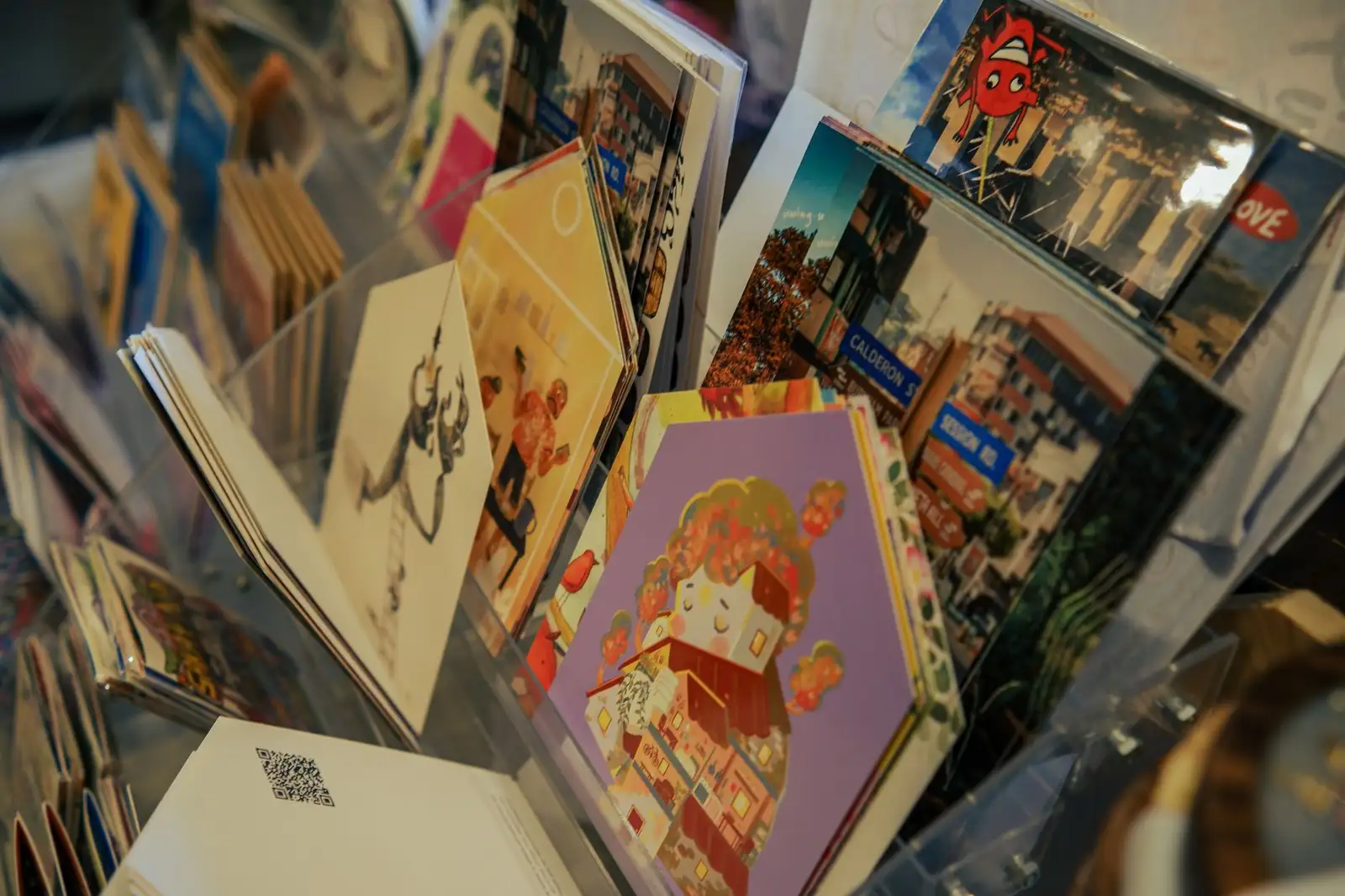

The rack is still there. It sits outside a tabacchi on the SS2, the old Via Cassia, a few kilometers before you reach Soriano nel Cimino, and it turns on a rusted spindle that squeaks if you touch it, though almost no one touches it anymore. Forty-some cards, maybe fewer now, sun-bleached until the sky in every photograph has gone the color of weak tea. A castle. A fountain. A church interior nobody remembers the name of. One card, near the bottom, still shows the price in lire, a currency that stopped existing before some of the customers who might buy it were born.
I've driven past that rack for more than twenty years. I don't think I've ever seen anyone buy a card from it.
There's something almost unbearably sincere about a postcard rack nobody uses. It was built for a kind of communication that made sense before phones held cameras, when the only way to tell someone I was here, I thought of you was to hand a stranger behind a counter a coin and a folded rectangle of cardboard with someone else's photograph of the place you were standing in.
Now we send the photograph we took ourselves, instantly, from wherever we're standing, with no lag and no need for a stamp. The postcard rack outside that tabacchi is a monument to a form of patience that doesn't exist anymore. It's also, I've come to think, a monument to something else: the admission, built right into the object, that a place cannot really be sent. Only pointed at.
I picked up one of those cards once, years ago, mostly out of boredom while a driver loaded a van outside. The photograph on the front showed the same fountain that was, at that moment, twenty feet behind me, throwing its actual water into actual light. I remember standing there holding a flattened, laminated version of the thing I could simply turn around and look at, and feeling a small, specific kind of vertigo. The card wasn't wrong, exactly. It just wasn't the fountain. It was a claim about the fountain, made by someone else, printed in a factory somewhere, sold at a discount to a shop that had probably ordered too many in 1994 and never sold through the box.
Here is a genre of writing that has mostly gone extinct with the object itself: the Weather is beautiful, wish you were here line, scrawled sideways because there wasn't enough room, sent to someone who would receive it two weeks after you were already home, so that by the time the sentiment arrived, it was already a lie. Not a malicious one. Just a small, structural one, built into the form. You cannot describe a place from inside it. You can only describe it after, from somewhere else, once it has already turned into memory, which is a different substance entirely.
I think about that lag a lot, the gap between being somewhere and being able to say anything true about it.
There's a number I keep coming back to, from the work I've done for the last two decades running small culture-based trips in Italy, and later in Portugal, Spain, Croatia, Argentina, and Uruguay. More than three quarters of our guests either return themselves or arrive because a friend sent them, rather than because of anything we advertised. When people write to us afterward, an enormous number of them open with some version of the same sentence: I don't know how to explain this week to anyone. They've just spent real money and real time on something, and the first thing they do, sitting down to describe it, is admit they can't.
That's the postcard problem again, just wearing different clothes. You cannot send the fountain. You can only point at it, badly, and then, often, just tell the person to go themselves.
I don't think that's a failure of language exactly. I think it's what happens when an experience is made of texture rather than information. You can tell someone the name of a hill town. You can even tell them what year the church was built, if you looked it up. What you can't easily transmit is the particular quality of standing in Paola's mother's kitchen while she shows you, without a single wasted motion, how to hold the knife against a leg of prosciutto so the slice comes away in one piece instead of shredding. That's not a fact. It's a kind of knowledge that lives in the hands and in the room, and it resists being folded into a rectangle and mailed.
The Paris Review has written, in its ongoing attention to the small forms of travel writing, about the peculiar intimacy of the postcard as a genre unto itself, a message that is by design both public (anyone in the postal chain can read it) and impossibly private, addressed to exactly one person who already knows what the sender's handwriting looks like. That double nature, public image on one side, private scrawl on the other, is maybe the closest object we've had to what a real trip does to a person. The photograph on the front is for everyone. The five lines on the back are for no one but you, and even you will find them thin, later, next to what actually happened.
The tabacchi with the postcard rack sells other things now, mostly: cigarettes, lottery tickets, phone credit, the small bottled coffees people drink standing at the counter before getting back in the car. The postcards are inventory nobody restocks and nobody removes. I asked the woman behind the counter once, years ago, whether she ever sold any. She shrugged in the specific Italian way that means why would you ask me something so obviously answered by looking at them, and said something like, tourists don't need them anymore. Then she sold me a coffee and didn't think about it again.
I thought about it for years.
Because what she was really saying, without quite meaning to, was that an entire way of proving you had gone somewhere had simply stopped being necessary. We carry the proof now, thousands of images of it, in our pockets. What we've lost, maybe, is the ten minutes of standing at a spinner rack turning it slowly, reading the backs of cards you weren't going to buy, deciding which single image out of forty badly printed choices came closest to matching what you'd actually felt standing in that place. That was its own kind of attention. A forced, funny, low-stakes act of translation. You had to choose one photograph to stand in for a day.
Now we don't choose. We just keep everything, and the keeping becomes its own kind of forgetting, because a folder of four hundred photographs asks nothing of you the way one chosen postcard did.
I don't want to make this sound like a complaint about phones, because it isn't, quite. Granta and other magazines devoted to travel writing have spent decades documenting how every generation mourns the tool the previous one used to fail at describing a place, and I don't think I'm doing anything more sophisticated than that here. The letter writer mourned the postcard. The postcard writer, if pressed, probably mourned some even older, slower form, a hand-copied journal entry sent by ship. Every method of trying to send a place to someone who wasn't there is inadequate in its own specific way. The rack outside Soriano nel Cimino just happens to be the one I keep driving past.
What strikes me now, turning it over, is how the postcard's failure and the memory's failure are actually the same failure, just at different speeds. A postcard fails instantly and obviously: the photograph is flat, the fountain has no sound, the light is wrong. A memory fails slowly and invisibly. You think you remember the fountain perfectly, the exact pitch of the water hitting the basin, the smell of the diesel from the road, the particular tiredness in your legs from the walk up from the lower town. And then ten years pass, and you realize you've replaced the actual sensory memory with something closer to a postcard of it: a flattened, agreed-upon version, maybe partly borrowed from a photograph you took, maybe partly invented, sanded down until it's portable and repeatable, something you can tell at dinner parties without effort.
We all do this. We are all, eventually, holding a postcard of our own life instead of the life.
There's a particular kind of roadside stop I think about more than the fountain town, though. Not a monument, not a church, just an ordinary autogrill on a stretch of highway between somewhere and somewhere else, the kind with the plastic chairs bolted to the floor and the espresso machine that's slightly too loud. Nobody photographs those. Nobody buys a postcard of a gas station bathroom or the particular quality of fluorescent light over a case of prepackaged sandwiches. And yet I could describe that light to you right now, decades later, with more precision than I could describe most of the cathedrals I've stood inside.
Why does that stick and the fountain fade?
I suspect it's because the autogrill asked nothing of me. I wasn't trying to remember it. I wasn't composing it into anything, not even a mental postcard. It just happened to me, sideways, while I was thinking about something else entirely, maybe worrying about a delayed flight or half listening to a conversation in the front seat. The places we try hardest to capture are often the ones we remember worst, because the trying gets in the way. The places that just happen to us, the ones we never once thought to photograph, sometimes stay whole.
That's not a tip. I don't have a system for it, and I distrust anyone who claims to. But it's the reason, I think, that so many people, after a week spent in real kitchens and small towns they'd never heard of before landing, come home unable to describe the actual sights and instead find themselves talking about a specific old woman's hands, or a specific unremarkable lunch that ran four hours longer than it needed to. Nobody plans to remember the lunch. The lunch simply refuses to leave.
I went back to that rack a few months ago, mostly to see if it was still there. It was, spinning a little stiffer than I remembered, the same castle, the same fountain, the same church interior, all of it a shade more sun-bleached than before, as if the cards themselves were slowly becoming postcards of postcards. I turned it once, the way you'd spin a globe you weren't really looking at, and thought about buying one, just to have it. I didn't. I'm not sure why. Maybe because I already knew what I'd do with it: put it in a drawer, forget it, find it in three years and feel a small, specific ache I wouldn't be able to fully name.
Which is, I suppose, exactly what the card was for all along.
Somewhere in that drawer, if I'd bought it, it would have gone on quietly failing to be the fountain, the way every photograph fails to be the thing, the way every story I've ever told about twenty years of driving that road fails to be the road. The failure isn't a defect. It might be the whole point of the object. A postcard doesn't ask you to believe the image is the place. It only asks you to remember that you once stood close enough to a place to send someone a picture of it, and that closeness, brief and ordinary and already over by the time the stamp went on, is the only part that was ever really true.
The rack still turns, if you touch it. Almost no one does. I think that's fine. Some things are allowed to go on quietly not being needed, spinning a little in the wind off the Cassia, holding a version of a fountain that nobody will send and nobody will buy, right next to the real one, which keeps running whether anyone's watching it or not.
Comments (0)
No comments yet. Be the first!