
The alleyway that remembers
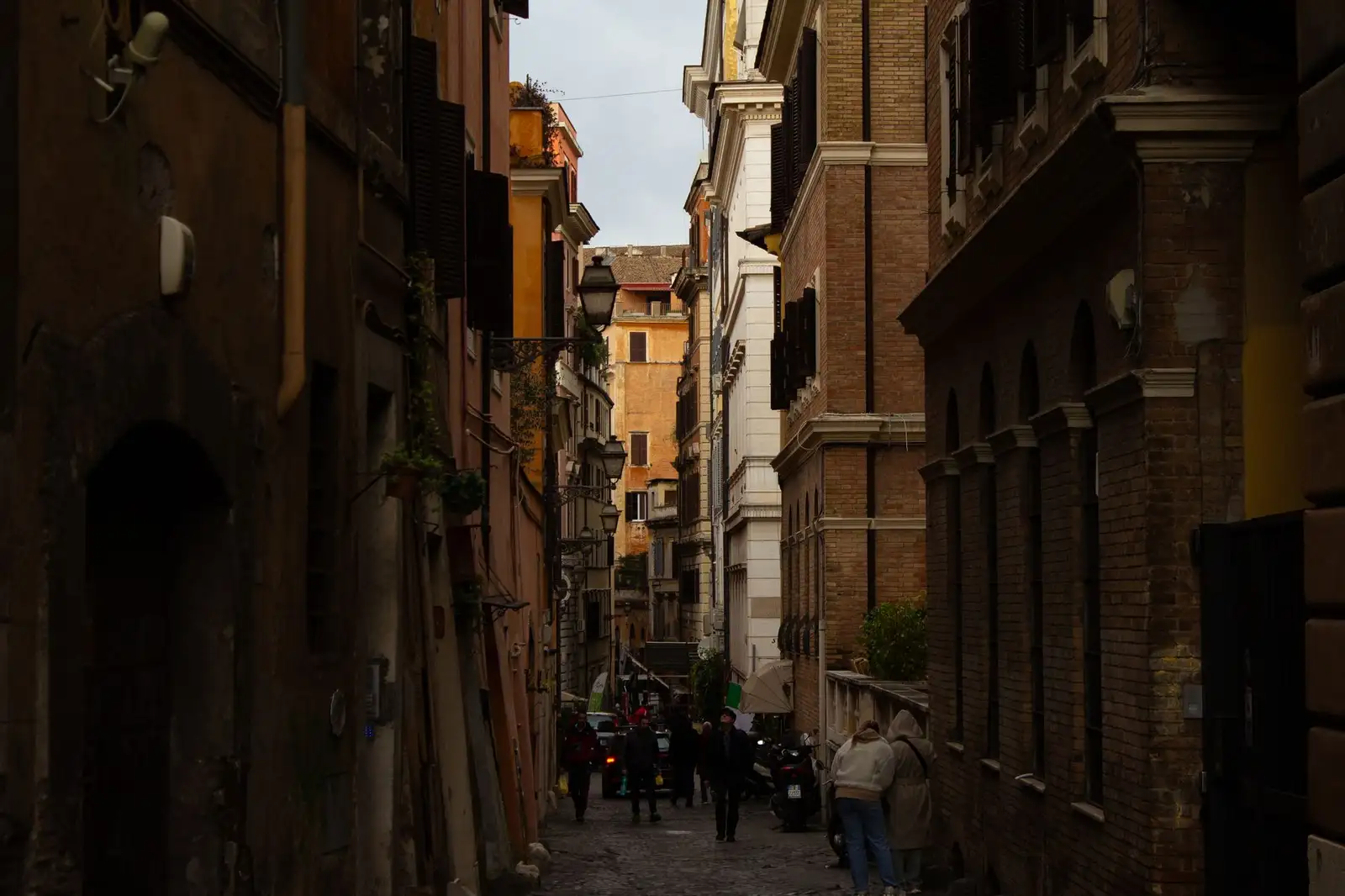
It is nearly eight in the evening in Trastevere, and the light has gone the color of weak tea. I am lost, which in this part of Rome is not a problem but a condition you learn to enjoy, on a street no wider than a hallway called Vicolo del Cinque. A woman three floors up is shaking a tablecloth out her window and the crumbs fall past me like a small, dry rain. Somewhere a scooter whines and dies. A cat watches from a doorstep with the patience of something that has outlived several governments.
I didn't come to Rome for this street. I came, like everyone, for the Colosseum and the Forum and St. Peter's dome, the postcard Rome that sells three million tickets a year. But it is this alley, and a dozen others like it, that I keep thinking about months later. Nothing happened in it. I stood there for four minutes and then I kept walking. And yet the four minutes have stayed with me longer than the Sistine Chapel did.
These narrow streets carry a particular quiet: built from accumulated footsteps rather than the absence of sound. The tourists don't usually find their way here, not because the alleys are hidden, but because they don't photograph well. There's no plaque. No ticket booth. Old walls lean slightly toward each other, close enough in places that you could touch both sides at once, and underfoot the sampietrini, the small black cobblestones cut from basalt that have paved Roman streets since the sixteenth century. Pope Sixtus V ordered the first of them laid around 1585, according to the city's own records on Rome's urban heritage, and workmen have been setting them by hand, one at a time, in the same herringbone pattern ever since.
What the stones carry
The sampietrini are the detail that undoes me every time. They're not flat the way asphalt is flat. Centuries of cart wheels and shoe leather and rain have worn each stone into its own small, individual slope, so that walking on them at night, slightly unsteady from wine, feels like walking across the backs of a thousand sleeping animals. My ankle rolls on the same uneven edge that rolled under a Roman cobbler's apprentice in 1690, under a German pilgrim in 1850, under a woman fleeing north in 1944 with her shoes in her hand because the leather soles made too much noise on the stone.
I don't know those people. I'm inventing them, probably, filling the alley with ghosts because the alley seems to want ghosts in it. The stones themselves are real, not invention. They are the oldest continuously used paving material in the city, repaired and relaid but never fully replaced, and the city of Rome still trains a small corps of selciaroli, stone-pavers, to maintain them by hand because machine-laid substitutes don't hold up the same way on streets this old. It's municipal policy, not sentiment, and it means the street under my feet on Vicolo del Cinque is, materially, the same street that was there when Caravaggio was getting into bar fights two neighborhoods over.
There's an essay in Harper's archive of writing on Italy about how a place can hold time not as history but as texture, felt through your feet before you understand it with your head. I think that's closer to what happens in a Roman alley than anything you'd call sightseeing. You're standing on the past, and it gives slightly under your weight.
The walls have more to say
If the stones carry the weight of feet, the walls carry everything else. Rome does not renovate the way other cities renovate. A wall in Monti, on Via dei Serpenti or down one of the side streets off it, might show four or five eras at once: a strip of medieval brick exposed where plaster has fallen away, a patch of nineteenth-century stucco painted the particular ochre-orange that the city still calls Roman red, a scrawl of 1970s political graffiti half scrubbed and half left, and over all of it, a newer layer of moss and soot and pigeon lime that doesn't discriminate between centuries.
I stood in front of one such wall on Via del Boschetto for long enough that a man selling leather wallets from a folding table asked if I wanted help finding something. I wasn't looking for anything, really. I was trying to read the wall the way you'd read strata in a canyon, trying to figure out which crack belonged to which earthquake, which window had been bricked up and when and why. I never worked it out. The wall isn't offering an answer. It's offering evidence that someone lived here, then someone else lived here, then someone else, and none of them erased the one before entirely.
There's a word Italians use for this that doesn't translate cleanly: stratificazione, stratification, but with none of the clinical distance the English word carries. It's how Romans talk about their own city, as a thing built in layers the way a lasagna is built in layers, each one visible if you know to look for the seam. You see it most honestly not at the ruins, which have been cleaned and roped off and interpreted for you by a small bronze sign, but in the alleys nobody bothered to curate, where the layering happened and kept happening because nobody had the money or the inclination to start over.
A woman, a goat of a different kind, and no language at all
On my second visit to Rome, a few years after that first wrong turn in Trastevere, I was staying near the Campo de' Fiori and took the wrong alley again, this time on purpose, to see where it went. It went to a courtyard off Via dei Giubbonari where an old woman was shelling fave beans into a bowl on a kitchen chair she'd dragged outside. She looked at me the way you'd look at a cat that had wandered in, not unkindly, assessing whether I was going to be a problem.
I said buonasera. She said buonasera back, then something fast and Roman-dialect that I didn't catch at all. I made the universal face of not understanding, and she laughed, not at me exactly, more at the whole situation of an American standing in her courtyard looking lost. She held out the bowl and gestured for me to try a bean, raw, straight from the pod. It was bitter and green and nothing like the beans I knew, and she watched my face change and laughed again, harder this time.
We exchanged no words of real meaning. I don't know her name. I never saw her again. But I think about that courtyard more than I think about the Pantheon, which I also saw that week and which is, by any reasonable measure, one of the most extraordinary buildings human beings have ever put up. The Pantheon asks you to be impressed. The courtyard asked nothing. It simply continued being what it had been for a very long time, and I happened to walk into it for ninety seconds, and it let me.
The sound a narrow street makes
There's an acoustic quality to these alleys that I didn't expect and still can't fully explain. Sound behaves differently in a street six feet wide with walls four stories high than it does on a piazza. Voices carry up instead of out. A conversation on a third-floor balcony drops down into the street below almost whole, so that walking through certain alleys at midday you catch fragments of other people's arguments, cooking instructions, a baby crying two buildings over as clearly as if it were crying beside you.
At night the effect reverses. The same walls that amplify by day muffle by night, and footsteps that would be lost in an open street echo instead, bouncing once off each wall before they reach you, so that walking alone down Vicolo della Pace near Santa Maria della Pace after midnight, you hear your own steps as a kind of call and answer, as though someone were keeping pace with you a building ahead or behind. The first time this happened I turned around twice, certain I was being followed. It was only the street doing what the street does to sound, the way it has always done it, because the geometry of the alley hasn't changed since whoever built it decided how close the buildings should stand.
I've since learned this isn't purely a Roman phenomenon. Narrow medieval streets everywhere produce something like it, in Siena, in parts of old Naples, in the souks of Fez. But in Rome it feels specific to the place because the alleys are so insistently old and so stubbornly unrenovated into anything resembling modern urban planning. Rome's city center was never leveled and rebuilt on a grid the way so much of London was after the fire, or so much of Lisbon after the 1755 earthquake. Rome kept building on top of Rome, bending its streets around whatever Roman, medieval, or Renaissance structure happened to already be standing in the way.
What it does to a sense of self
Here's the part I find hardest to put into words without it sounding like something off a scented candle. Standing in these alleys shifts how you locate yourself in time. It's smaller and stranger than cosmic. It's the feeling of being one entry in a list that is extremely long and that you will never see the whole of.
Somewhere on Via del Pellegrino, which has been a street since at least the Middle Ages, named for the pilgrims who walked it on their way to St. Peter's, I had the thought that the street didn't care whether I lived or died. That was oddly comforting. It had carried pilgrims, soldiers, fishmongers, printers (the street was once Rome's center for the printing trade), and would carry whoever came after me, long past any memory of my having been there at all. I was briefly part of its ongoing foot traffic, same as everyone else who'd ever walked that stretch of stone, and the street would forget me exactly as thoroughly as it had forgotten all of them, which is to say completely. The forgetting wasn't an insult. It was the terms of admission.
The Paris Review has run essays on the particular psychological pull of old cities, the way certain streets produce a kind of humility that has nothing to do with religion and everything to do with scale, of time rather than space. That's the right frame for what these alleys do. The Colosseum tells you Rome was great. A quiet street off the Campo Marzio tells you that you are current, not permanent, a tenant rather than an owner, and that most people who ever stood exactly where you're standing left no record of having done so at all. Somehow that's not bleak. It's closer to relief.
The parts that are disappearing
I should say, because it would be dishonest not to, that a lot of this is eroding. Airbnb listings have taken over whole buildings in Trastevere and Monti, and the old women shelling beans on kitchen chairs are getting harder to find because their grandchildren have moved to Tiburtina or out of Rome altogether, and the ground-floor spaces that used to be a cobbler's shop or a hardware store are becoming the fourth natural wine bar on a street that's maybe two hundred meters long. Residents' associations in Trastevere have been pushing back on this for years, with limited success, and you can feel the texture of the neighborhood thinning even over the span of a few visits a decade apart. The layers are still there in the walls. But the living ones, the courtyard conversations, the balcony arguments, the laundry lines, are getting replaced by rolling suitcase wheels on the sampietrini, a sound the stones were never quite designed for and don't handle gracefully.
I don't say this to be grim about it, and I don't think the alleys are in danger of losing their voice entirely. Rome has survived worse than tourism. The specific feeling I'm describing, the sense of walking into a conversation that's been going on since before you arrived and will continue after you leave, depends on there still being a conversation to walk into. It depends on the old woman with the fava beans still being out on her chair. Every year there are fewer chairs.
Finding it on purpose
If you want this feeling and not the postcard version, here's the only advice I have, offered with no authority beyond having wandered badly and often. Go at the hours the tour groups skip. Early morning, before eight, when the shutters are still half down and the only people on Via dei Coronari are men hosing down the pavement outside their own shops. Or late, after eleven at night, when the restaurants in Trastevere have cleared out and the alleys belong to residents walking dogs and a few people smoking alone on stoops.
Leave the map in your pocket. Not off, not uninstalled, unconsulted for twenty minutes at a stretch. Being lost in central Rome rarely costs you more than ten extra minutes and almost always gets you somewhere better than where you were headed. Pick a direction by which side the light is hitting the wall. Follow a smell of bread or frying artichokes instead of a street name. Stop when a wall looks like it's been through more than the others and look at it, long enough that it stops being architecture and starts being a kind of writing you can almost, not quite, read.
You won't find a plaque explaining any of it. That's correct. The plaques are for the parts of Rome that have finished happening. The alleys are for the part that's still going on, quietly, underfoot, in the particular slant each stone has worn into itself, waiting for whoever walks over it next to notice, or not, and either way to keep walking.

Comments (0)
No comments yet. Be the first!